
Discovering Classical Roots Through Cartoons: The Legacy of Rossini’s The Barber of Seville
For those of us who grew up in the 1950s to 1970s, classical music and opera often found their way to us not through grand concert halls, but rather through the playful lens of cartoons. A quintessential example of this phenomenon is Gioachino Rossini’s opera The Barber of Seville. I was fortunate to experience this delightful work at the San Francisco Opera, a testament to its enduring charm across generations.

The Comedic World of The Barber of Seville
Rossini’s The Barber of Seville is categorized as an opera buffa, highlighting its comedic elements. Its whimsical Italian humor and absurd plot twists make it a beloved favorite for many. My own introduction to Rossini came through the beloved Bugs Bunny cartoon titled Rabbit of Seville, which was released in 1950. In this cartoon, Bugs Bunny lifts the original opera’s elaborate scenarios, transforming Elmer Fudd into a hilariously unwilling customer.
Unlike the original opera, Bugs’s rendition omits the romantic subplot and the cunning female character Rosina, yet as children, these omissions didn’t matter. The vibrant melodies that ensnared our young minds served only to later reveal themselves as masterpieces of classical composition.
The Magic of Absorbing Opera as Children
I fondly recall dancing around the living room while watching Bugs Bunny, donning my grandfather’s hat and wielding my great-grandmother’s cane. As children, we absorbed the rhythms and intricacies of opera without even realizing it. This music broadened our consciousness in ways that remain mysterious and profound. Many of us were unknowingly raised on the same composers—Rossini, Wagner, and others—before we ever crossed the threshold of an opera house.
The Multi-Dimensional Experience of Opera
Opera offers an immersive combination of music, storytelling, language, breath, movement, symbolism, and emotion that’s difficult to match. While musicals evoke a desire to get up and dance, opera demands a different sort of engagement. The drama presented, paired with the slower pace of repeated musical phrases, allows us to digest the emotional heft behind the words—often exhibited through supertitles alongside the action on stage.

Presence and Emotional Resonance
Engagement in opera invites a deep focus that psychologists describe as a form of immersive experience. Audiences often report a tranquil silence within, where internal chatter lessens, fostering a heightened awareness of the present moment. Spiritually, this can be seen as a transition from ordinary to expanded consciousness, affecting how we relate to the world around us.
The human voice conveys an extraordinary amount of emotional information—tone, breath, vulnerability—that is magnified in an opera setting. These emotional signals invite listeners to access deep feelings, often leading to profound experiences within ourselves and others. I recall a male friend tearing up during a particularly moving aria when he had never shown such emotion before.
The Healing Power of Sound
In my own experience, I’ve witnessed the power of musical tones in healing and emotional release. Whether through the chants of yoga, the reverberation of gongs, or the delicate tones of crystal bowls, sound seems to touch the very essence of our being. Neuroscientific studies support these observations, revealing music’s ability to activate networks related to emotion, memory, and bodily sensations.
Certain frequencies, connected to the ancient concept of Solfeggio frequencies, align with the chakras within our bodies, potentially invoking feelings of balance and healing. While skeptics may dismiss claims of frequency-based healing, personal experiences often tell a different story—one where sound offers a pathway to deep emotional exploration.
Exploring the Themes of The Barber of Seville
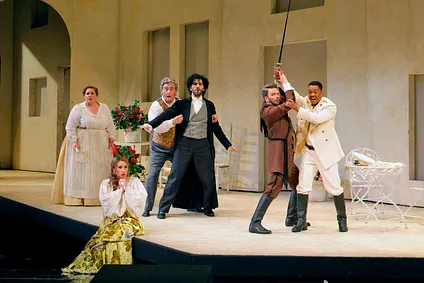
Set against the backdrop of Seville, the storyline follows Count Almaviva, a young nobleman smitten with the clever Rosina, who is under the strict supervision of her guardian. The opera’s themes of love, freedom, and self-identity mirror the struggles faced in our own lives. Almaviva’s journey—disguising himself and seeking the help of the charismatic barber Figaro—can be seen as a metaphor for resilience in the face of social constraints.
Figaro, the barber, mirrors the resourcefulness and humor that many of us remember from Bugs Bunny. His antics, charm, and wit exemplify the broader theme of intelligence and creativity triumphing over authority and convention.
The Call for Freedom
One of the opera’s most compelling aspects is its commentary on freedom—both external and internal. Rosina’s desire to escape her life’s constraints resonates with the broader human experience of yearning for autonomy. The humorous misunderstandings and secret identities create a narrative that’s relatable across time, inviting us to navigate the complexities of love and personal choice.
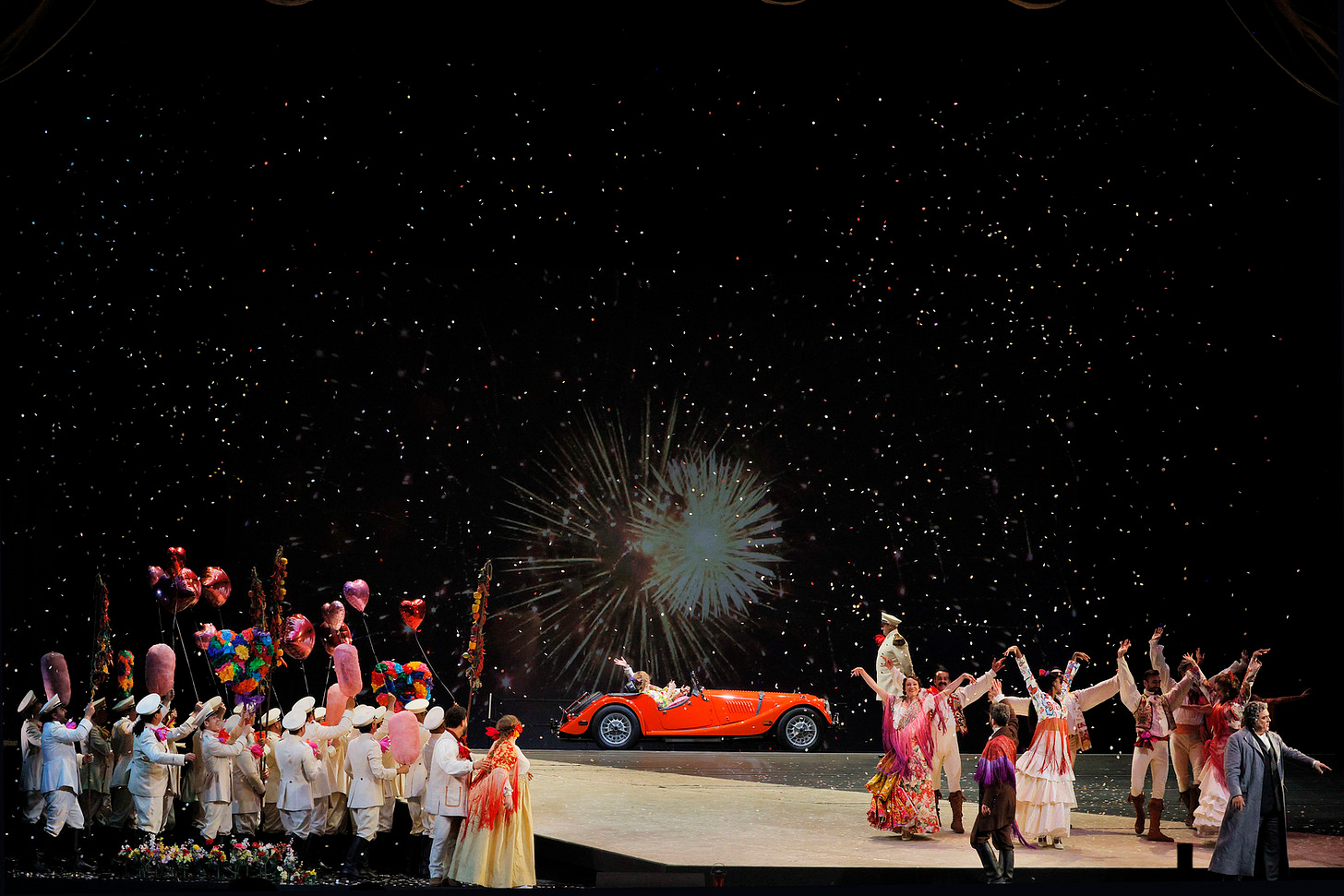
In the modern staging I witnessed, the depiction of a luxury red convertible and fireworks added a whimsical twist, enhancing the absurdity and humor of the production, while simultaneously resonating with the opera’s essence.
Resonating Themes Across Time
Operating within the historical context of its 1816 premiere, The Barber of Seville explores themes of freedom, identity, and societal expectation, themes still relevant today. The clever storytelling and universal themes play a key role in ensuring that this opera speaks to us, regardless of the age we live in.
Rossini’s work, like Beaumarchais’ original play, portrays the importance of love, longing, and rebellion against oppressive social systems. These are not just the characters’ struggles; they are our own, reflected through the lens of opera.
As we resonate with the chaos and absurdity of life presented on stage, we find ourselves deeply connected to the emotional truths of the human experience.