
Exploring the Harper Basin: A Collaborative Venture for Hydrocarbon Prosperity
In an ambitious initiative, a Liberian subsidiary of France’s energy powerhouse TotalEnergies (TTE) is teaming up with BluEnergies (BLU), a Canadian-based company specializing in oil and gas exploration, to advance drillable prospects in the Harper Basin off the coast of Liberia. This collaboration signals a growing interest in the West African energy sector, highlighting both the region’s geological potential and its strategic importance in the global energy landscape.
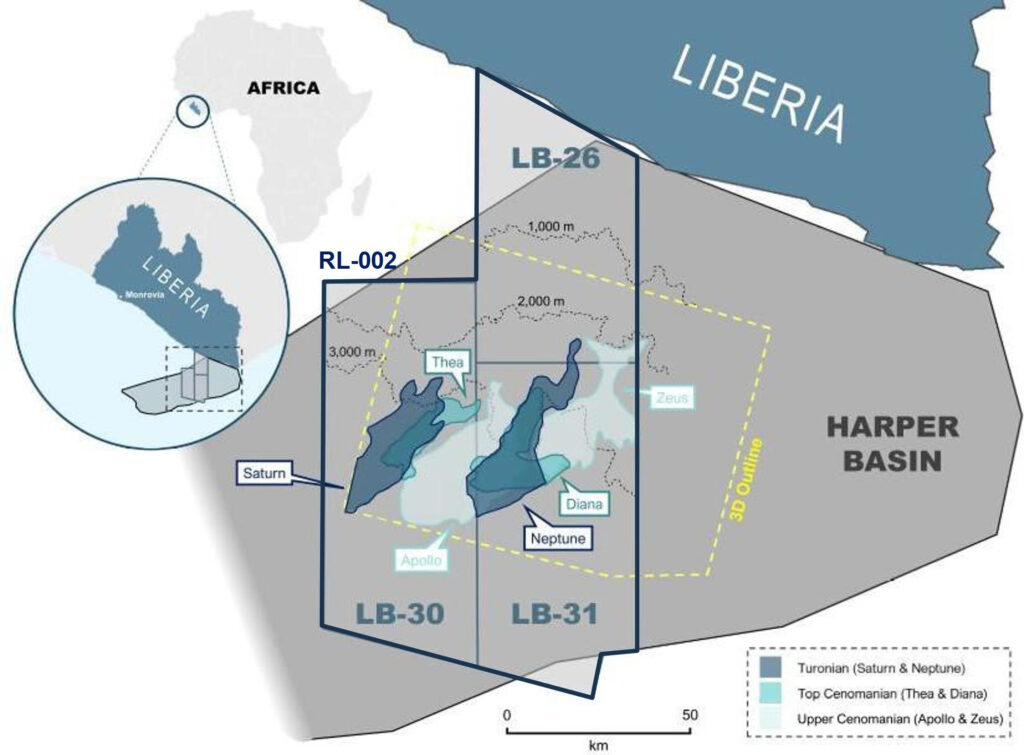
Focusing on the LB-26, LB-30, and LB-31 blocks, BluEnergies and TotalEnergies are diligently working to reaffirm and enhance the drillable prospects within these areas. As part of their ongoing work program, the reprocessing of 6,167 square kilometers of existing 3D seismic data is already over 50% completed, with preliminary results promising to yield valuable insights into the geological features beneath the waves. TGS, charged with this complex task, aims to improve the seismic character and amplitude variation with offset (AVO) content of earlier surveys conducted in 2013.
To gain a comprehensive understanding of the Harper Basin, GeoPartners has been commissioned to carry out a multi-beam echo sounder survey (MBES), covering an area of 4,045 square kilometers. This survey plays a crucial role in identifying underwater terrain, revealing seabed anomalies, and supporting the safe selection of potential drilling sites.
In the words of Sergio Laura, BluEnergies’ VP of Exploration, “The West Africa Transform Margin, where the Harper Basin is located, and its conjugate South American Margin are regions where basin floor fan plays are being actively and successfully explored, developed, and produced.” His observations highlight the significant strategic value of this collaboration, as major oil companies aggressively pursue deepwater licenses along the African west margin.
As part of the MBES initiative, BluEnergies is utilizing the R/V Gyre vessel, which belongs to TDI-Brooks. The data acquisition started on June 19, 2026, and is expected to conclude by the third quarter of the same year. This geological surveying is not merely an exercise in mapping; it is a foundational step that will lead to better drilling strategies and improved understanding of the hydrocarbons present in the basin.
The MBES facilitates the identification of seabed geomorphology, reveals the presence of anomalous features, and conducts water column imaging. These advanced techniques all contribute to detecting potential hydrocarbon seepage through the seafloor. Additionally, sediment analysis via piston coring aims to gather insights into migrated mature hydrocarbons, further enhancing the geoscientific understanding of the subsurface geology.
Complementing these efforts are heat flow measurements designed to assess sediment temperature and thermal history. This information is crucial for predicting the presence and mobility of hydrocarbons beneath the surface. Ultimately, the goal of these initiatives is to create a refined 3D interpretation of the various leads within the blocks by the fourth quarter of 2026, paving the way for informed and safer drilling decisions.
Through this collaborative endeavor, BluEnergies and TotalEnergies are positioning themselves at the forefront of offshore exploration in a region brimming with potential. The Harper Basin represents not just an exploration frontier but a gateway to energy security and economic development for Liberia and West Africa as a whole.