
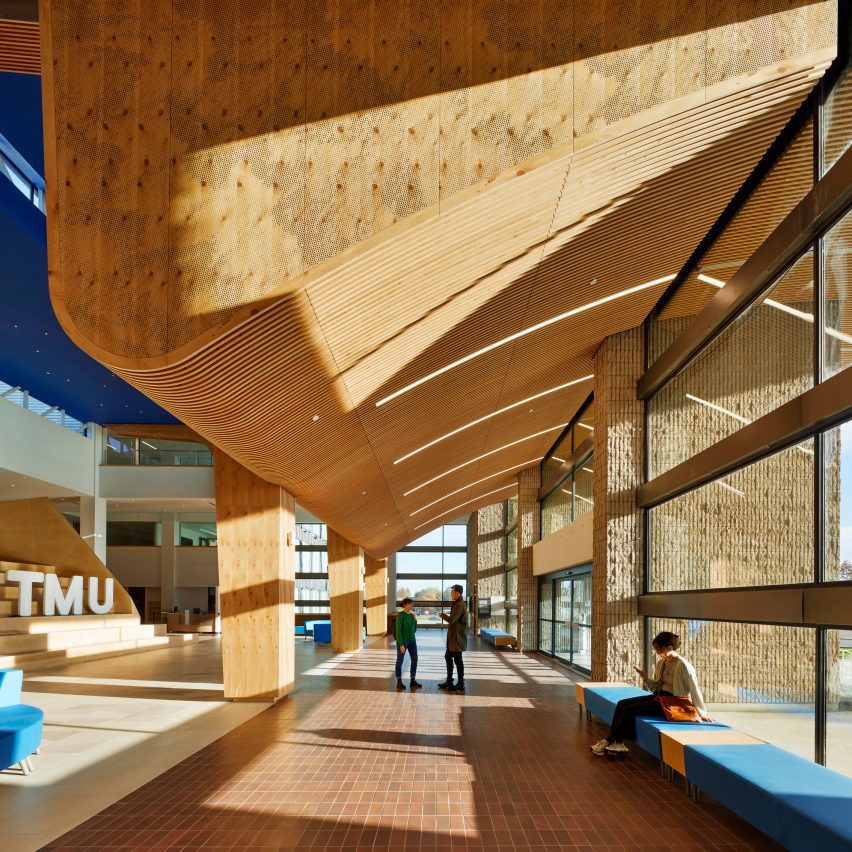
Canadian architecture firm Diamond Schmitt has completed phase one of Toronto Metropolitan University’s new School of Medicine, an inspiring blend of modern design and community-oriented functionality. The establishment features striking wood-clad structural elements alongside bold blue accents, creating a welcoming atmosphere for students, faculty, and the public.
### Adaptive Reuse and Transformation
The TMU School of Medicine finds its home in the revitalized former Bramalea Civic Centre. Diamond Schmitt’s transformation gives new life to the original 1970s brutalist structure, imbuing it with light, openness, and transparency while preserving its grand civic presence. This adaptive reuse serves as a model for integrating academic space with health services, thus fostering a culture of learning and healing.
### Drawing from Nature and Culture
Senior associate Haley Zhou articulated the philosophy behind the design: “When we looked to transform the former civic building into a place of healing and learning, we drew inspiration from local ecologies as a way to bring new life to the space.” The building cleverly incorporates elements referencing the natural landscape, particularly drawing inspiration from the tall pines of nearby Chinguacousy Park—whose name translates from Ojibwe as “Land of Tall Pines.” Structural columns and an impressive entry canopy are wrapped in wooden fins, enhancing the connection to nature.
### A Gathering Space
At the heart of the School of Medicine is a large atrium designed to facilitate connection and collaboration. This vibrant hub serves students, faculty, and community members, creating an inviting atmosphere that supports interaction. The atrium’s design not only fosters academic exchange but also embodies the ethos of community involvement and care intrinsic to the school’s mission.
### Cultural Significance
The design goes beyond aesthetics; it actively engages with the cultural landscape of the region. An Ojibwe star map adorns the ceiling, symbolizing Indigenous knowledge, while preserved original floor tiles are interwoven with new patterns inspired by Wampum belts. This thoughtful integration reflects a commitment to honoring both the built environment and the rich cultural narratives that define the area.
### Facilities for Holistic Education
The ground floor of the building houses a public medical clinic, offering essential health services to local residents. This integration of education and healthcare reflects the institution’s commitment to serving its community and removing barriers to access. Above this clinic, highly flexible classrooms are designed to support various teaching methods, accommodating in-person, hybrid, and asynchronous learning configurations, thus catering to the diverse needs of students.
### Space for Indigenous Traditions
The library includes unique features, such as a round room dedicated to Indigenous smudging ceremonies and gatherings, emphasizing a commitment to cultural practices and community engagement. Informal learning spaces further enhance collaboration, providing areas for both quiet study and lively discussions.
### Future Development
Phase one marks a significant milestone, with upcoming plans for phase two expected to complete academic and faculty areas in the north wing of the building. This future development promises to enrich the school’s facilities, expanding the resources available for research and administration.
### A Lasting Legacy
By reimagining a former civic building as a center for medical learning and care, Diamond Schmitt not only extends the original purpose of the space but also modernizes it to support equitable access and community engagement. The TMU School of Medicine stands as a beacon of what modern architecture can achieve when coupled with a deep understanding of social responsibilities.
### Ongoing Projects
Diamond Schmitt continues to demonstrate its versatility and innovation in architecture, recently partnering with MVRDV to design a terraced research building for the University of Toronto. The firm is also spearheading projects like the New Brunswick Museum and the renovation of the New York Philharmonic’s David Geffen Hall, further establishing its reputation as a leader in contemporary architectural design.
The photography is by Tom Arban Photography.
The post Diamond Schmitt adapts civic centre into TMU School of Medicine appeared first on Dezeen.