
Norway’s state-owned energy giant Equinor has made a new oil find on the Norwegian Continental Shelf (NCS), putting on the table a potential tie-back to the country’s largest oil development ever brought on stream in the Barents Sea.
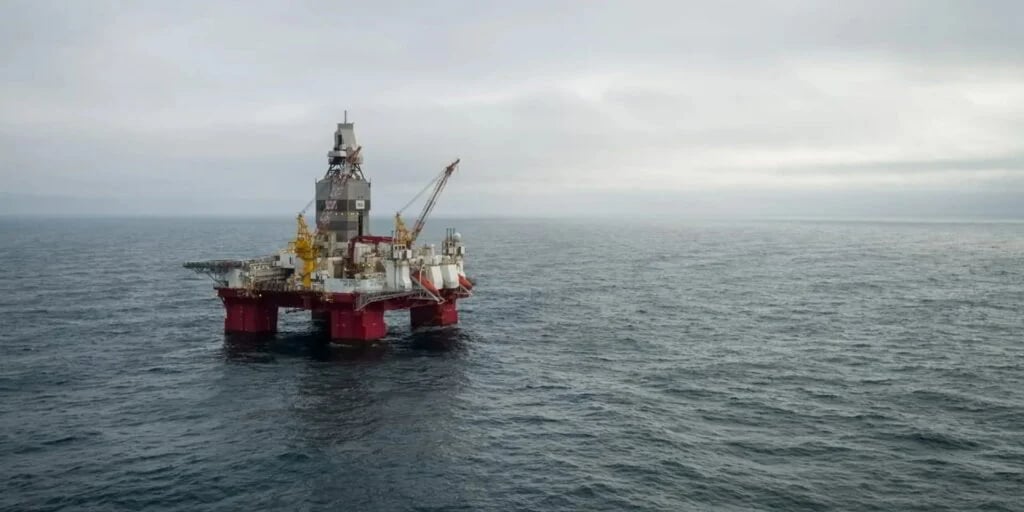
Equinor, in partnership with other energy stakeholders, has made a significant oil discovery in the Skrugard North Tubåen prospect located in the Barents Sea. This discovery stems from the recent drilling of the 7220/5-EC-2 H wildcat well, executed by the Transocean Enabler rig. Situated approximately 6 kilometers north of the earlier 7220/8-1 discovery well on the Johan Castberg field, this site lies 240 kilometers northwest of Hammerfest, marking an important developmental milestone for Norway’s energy sector.
This drilling represents the 17th exploration well within production licence 532, awarded during the 20th licensing round in 2009. Participants in this licence include Equinor as the operator, along with Vår Energi and Petoro. The well was primarily aimed at identifying petroleum deposits within the Lower Jurassic reservoir rocks found in the Tubåen Formation.
The findings from well 7220/5-EC-2 H revealed an impressive oil column of approximately 30 meters in sandstone, situated in the Tubåen Formation, which features a total of 41 meters of reservoir rock with commendable quality. The total thickness of the Tubåen Formation is 68 meters, and the oil/water contact was observed at 1,474 meters below sea level. Drilled to a vertical depth of 1,521 meters, the well ended within the Fruholmen Formation of the Upper Triassic strata. Although this well was not subjected to formation testing, valuable data and samples were collected, providing crucial insights for future operations.
At the drilling site, the water depth reached 361 meters, and following evaluation, the decision was made to permanently plug and abandon the well. According to preliminary estimates from the Norwegian Offshore Directorate, the discovery is assessed to hold between 1.2 to 1.7 million standard cubic meters of recoverable oil equivalent (o.e.), which translates to approximately 7.6 to 10.5 million barrels of o.e. Given the proximity to the Johan Castberg field, there is considerable interest in exploring the potential for a tie-back, leveraging existing infrastructure to maximize efficiency and output.
This new oil find is especially noteworthy, coming shortly after Equinor announced another discovery in the Polynya Tubåen prospect, identified through the 7220/7-5 well. This previous discovery has further reinforced the development of the Johan Castberg field, highlighting Equinor’s commitment to advancing projects within the Barents Sea region. The ongoing exploration endeavors not only signify a step forward in resource development but also play a vital role in contributing to Norway’s broader energy strategy, bolstering its position as a leader in the offshore energy sector.