
When the Daily Rhythm of the Tropics Disappears, Trouble is Near: Understanding Tropical Waves and the MJO
Sailing in the tropics brings a unique experience characterized by the rhythm of the climate. As you approach about 30° north or south of the equator, you’ll notice a distinct pattern: a twice-daily rise and fall in barometric pressure, overlaying the natural fluctuations caused by local high and low-pressure systems. Understanding these changes is key to predicting shifts in weather, especially concerning tropical waves and the Madden-Julian Oscillation (MJO).
The Dance of Atmospheric Pressure
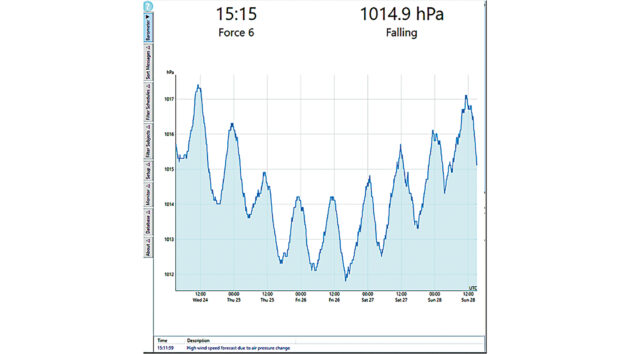
Venturing into tropical waters, mariners will observe that the barometer reflects a systematic behavior not commonly found in higher latitudes. You’ll experience slight fluctuations—typically around ±1.5-2hPa—coinciding with local time markers. Maximum pressure generally occurs at 1000 and 2200 hours, while minimums will register at 1600 and 0400 hours.
The rhythm of these fluctuations is essential for sailors. Why? Because they provide crucial information about local weather stability. If you notice these readings in your logbook, be sure to document the actual pressure rather than just writing down the corrected value.
The phenomenon arises as the sun heats the thermosphere—a layer of the atmosphere—causing the air to expand. This expansion creates a slight increase in pressure ahead of the sun (not exceeding 4hPa in 1,000hPa) at local noon, forming a wave pattern that causes maximum and minimum pressures to oscillate across the globe, rather like tides.
The Signs of Disturbance
Any significant diminishment or complete disappearance of these diurnal variations is a red flag—for sailors and meteorologists alike. Such a shift signals that an atmospheric disturbance may be brewing nearby, which could manifest as a tropical wave, a cluster of squalls with deep cumulus activity, or, depending on your location and timing, a tropical revolving storm. Recognizing these indicators is paramount for staying safe at sea.
Understanding Tropical Waves
Tropical waves, known in the North Atlantic as African easterly waves, stem from the significant temperature discrepancy between the Sahara Desert and surrounding seas. The Sahara, heating up considerably more than the ocean, creates a mid-atmospheric jet stream, termed the African easterly jet (AEJ).
This AEJ generates disturbances every two to three days, resembling eddies in fast-moving water, which translate into tropical waves moving westward at speeds of 15 to 25 knots. These waves bring about shifting winds, heightened convection, and increased squall activity.
While tropical waves are generally not dangerous, they can trigger hurricanes under specific conditions—especially during peak periods like September when up to 40% of these waves develop into named storms.
The Madden-Julian Oscillation
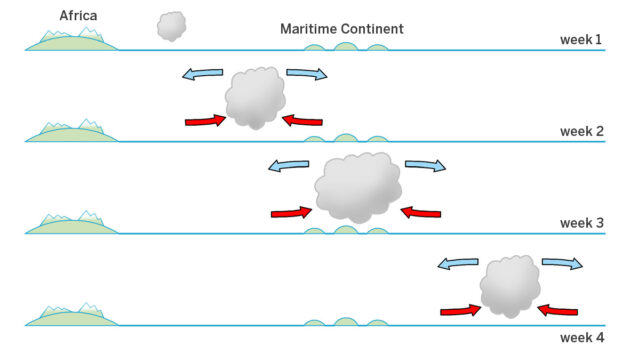
The Madden-Julian Oscillation (MJO) is an alternating pattern characterized by periods of increased or suppressed convection over a cycle of 30 to 60 days, moving through the tropical regions. It’s pivotal for understanding weather patterns at sea, particularly influencing conditions in the tropical Indian and West Pacific oceans.
The MJO’s impact is seen through the progression of convection areas, which start in the Indian Ocean before dispersing and intensifying over hundreds of miles. This dynamic can result in weeks filled with squalls or, conversely, stretches of clear skies.
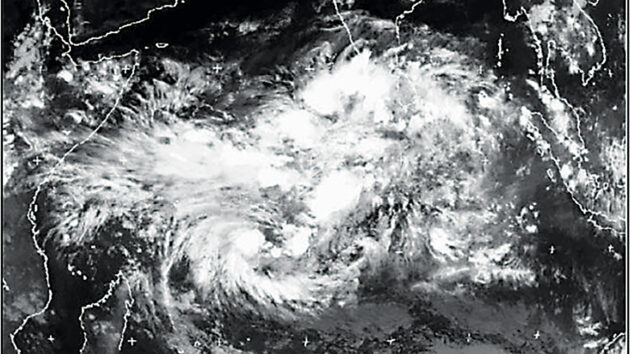
The MJO’s effect resonates with the northeast trades in regions like Singapore, intensifying these winds as the MJO approaches, and conversely weakening them during its departure. In some cases, the MJO can act as a catalyst for tropical storms, making it a crucial factor in storm forecasting.
By understanding these atmospheric phenomena—diurnal pressure changes, tropical waves, and the MJO—sailors can better anticipate and navigate the challenges that arise in tropical waters. Awareness of these signs not only enhances safety but also enriches the sailing experience, grounding it in the marvels of nature’s power.