
Pioneering Developments in Offshore Energy: The Launch of Acadia
Texas-headquartered Great Lakes Dredge & Dock Corporation (GLDD) has taken delivery of Acadia, the first U.S.-flagged, Jones Act-compliant subsea rock installation vessel (SRIV). This milestone marks a significant advancement in the U.S. offshore energy sector, particularly as the demand for renewable energy resources continues to grow.
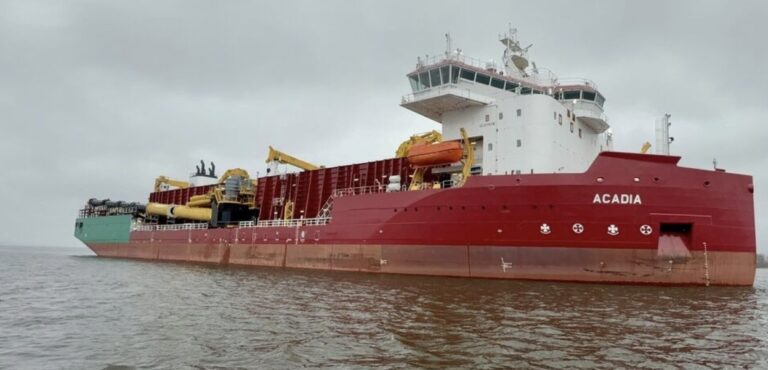
Source: Great Lakes Dredge & Dock Corporation
A Vision Realized
The journey of Acadia began when GLDD ordered the vessel from Philly Shipyard, Inc. in 2021. The preparation stages were crucial, with the first steel cut taking place in July 2023 and the keel being laid in May 2024. After several stages of construction and development, Acadia was launched into the waters of the Delaware River at Hanwha Philly Shipyard in July 2025. The vessel recently completed its essential sea trials in March, demonstrating its readiness for the tasks ahead.
Transformational Impact on Energy Infrastructure
“Taking delivery of Acadia represents a transformative moment for Great Lakes and underscores our dedication to installing and protecting domestic and international offshore energy infrastructure,” stated Lasse Petterson, the President and CEO of GLDD. This statement encapsulates the broader implications of Acadia’s launch, which signifies not just an addition to the fleet but a commitment to advancing energy solutions.
The SRIV, designed under the S211 model by Ulstein, is equipped to transport and install up to 20,000 metric tons of rock on the seabed. This rock serves as essential scour protection, safeguarding various subsea infrastructures including power transmission cables, telecommunications lines, oil and gas pipelines, and offshore wind turbine foundations.
Specifications and Capacity
Acadia boasts impressive specifications, stretching 140.5 meters in length and 34.1 meters in breadth, and can accommodate a crew of 45 people. Its size and specialization position it uniquely within the maritime sector, allowing it to handle complex underwater installations crucial to modern energy projects.
Future Deployments
Acadia’s initial tasks will focus on critical projects off the coast of New York. After its delivery, the vessel will mobilize for Equinor’s Empire Wind 1 offshore wind project, a significant undertaking aimed at bolstering the region’s renewable energy capabilities. Following this, it is scheduled to proceed to Ørsted’s Sunrise Wind project, also situated offshore New York.
Importantly, after fulfilling these U.S. commitments, Acadia is slated to travel to Europe, where it will begin rock installation for a major offshore wind developer throughout most of 2027. This transition illustrates the vessel’s global operational potential and the expanding market for offshore wind projects.
The Bigger Picture
The launch of Acadia highlights a strategic shift towards domestic capabilities in the offshore energy sector. By being Jones Act-compliant, Acadia can significantly contribute to U.S. energy security and independence. The vessel not only supports domestic projects but also paves the way for international collaborations, enhancing the U.S.’s position in the competitive global energy arena.
Ultimately, Acadia embodies the commitment to clean, renewable energy solutions while reinforcing the importance of advanced maritime technology in addressing contemporary energy challenges.