
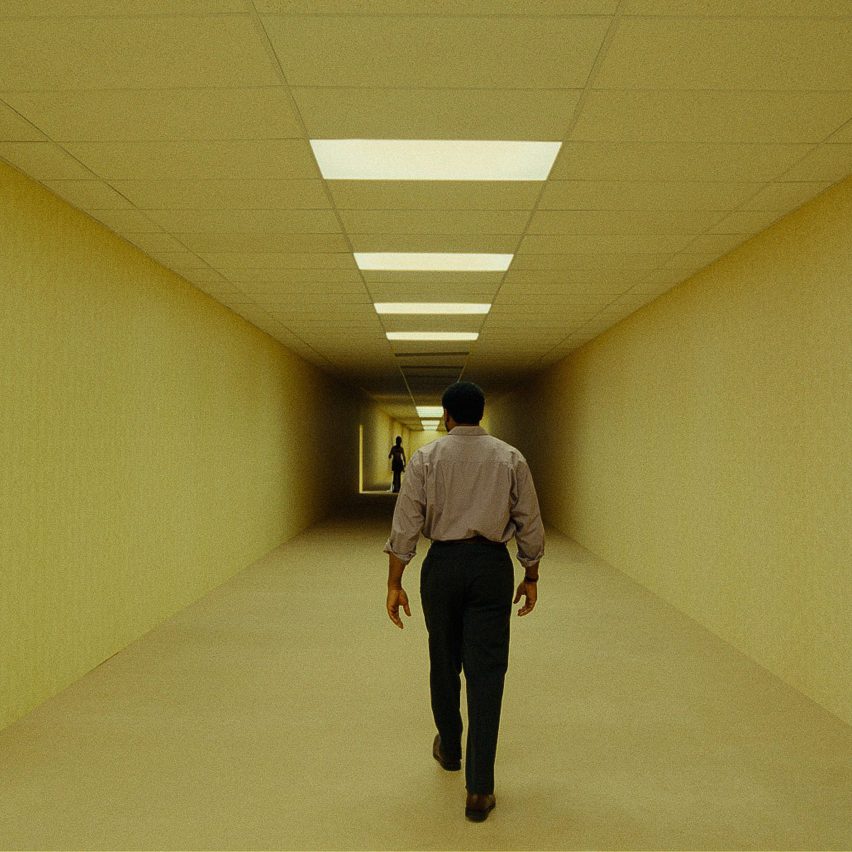
In recent months, the architectural horror film *Backrooms* has taken both audiences and critics by surprise with its unique premise and chilling execution. Edwin Heathcote reflects on the reasons behind our collective fascination with these endless corporate spaces that blur the lines between familiar and unsettling.
Have you ever had that dream where you find a hidden door in your home, leading to an endless corridor or a hidden room? It’s the thrilling premise of *Backrooms*, but instead of excitement, it reveals an unnerving fracture in our perception of space.
The movie has its roots in a series of low-budget, yet striking YouTube shorts produced by Kane Parsons, a 20-year-old filmmaker. These eerie narratives, often likened to a “creepypasta” urban legend, have resonated profoundly with viewers, tapping into the uncanny essence of abandoned corporate environments. The shorts depict a nightmarish journey through post-industrial spaces that seem all too familiar, blending elements of reality with psychological horror.
For much of horror’s history, the haunted house conjured images of gothic mansions filled with dark attics and chilling corridors.
The visual inspiration for these shorts stems from a real location: Rohner’s Home Furnishings in Oshkosh, Wisconsin, during its renovation into a hobby shop. The success of these films lies in their ability to evoke the discomfort of being trapped in sterile, fluorescent-lit corporate spaces—think the tension of *The Office* mixed with the unsettling corporate aesthetics seen in *Severance*, which draws from the same well as *Backrooms*.
Traditionally, haunted houses symbolized the epitome of terror. Movies such as *Psycho* and *House on Haunted Hill* solidified this notion, turning gothic grandiose into caricatures seen in shows like *The Addams Family*. But as our architectural landscape evolved, so too did our sources of fear.
George A. Romero, for instance, redefined horror by shifting the focus from haunted manors to the modern mall in *Dawn of the Dead*. Similarly, John Carpenter transplanted dread into the mundane suburbs in *Halloween*. Unlike the terrifying allure of the past, these contemporary settings represent a critique of commercialization and consumer culture.
The abandoned mall now stands as the quintessential site of horror, often referred to as “ghost malls” or “dead malls,” emblematic of late capitalist decay.
These commercial spaces have taken on a haunting quality, sparking a new branch of psychological exploration. Urban theorist Marc Augé coined the term “non-places” for such environments, suggesting they evoke a sense of alienation. The fascination surrounding these liminal spaces—an almost ubiquitous anxiety about emptiness, termed kenophobia—speaks to our collective discomfort with the transient nature of modern existence.
*Backrooms* further delves into this unsettling atmosphere, emphasizing defunct technologies like cassette tapes and analog phones. For many in Heathcote’s generation, these relics evoke nostalgia, while for younger audiences, they represent an almost alien past. In stark contrast to the accessibility of IKEA aesthetics, the film showcases furnishings that feel outdated and trapped in time.
The film’s protagonist, Clark, embodies this struggle; as an architect, he finds himself amidst poor design choices that reflect our societal decline. The back-of-house environments of hotels and hospitals serve as metaphorical landscapes, filled with unseen worlds contrasting with polished public facades. This architectural “hypocrisy” highlights the lesser-seen realities behind comfortable exteriors.
The dropped ceilings and the flickering fluorescent lights craft a labyrinthine ambiance of banality that feels infinities endless.
This architectural narrative evokes a sense of despair reminiscent of being a lab rat in an endless maze. Just as these creatures undergo existential experiments, *Backrooms* probes whether human beings, too, are subject to larger, unseen forces.
The implications surrounding the film’s ambiguous conclusion suggest that these uncanny spaces are not merely external. They serve as metaphors for internalized chaos—this overwhelming, mundane architecture personifies our anxieties and inefficacies, drawing upon the rich tradition of literary mazes from works like *House of Leaves* by Mark Z. Danielewski. In this narrative experiment, familiar spaces morph into nightmarish realms that challenge our perception of physical environments.
Could it be that these endless backrooms symbolize aspects of ourselves we fear to confront?
The nauseating yellow wallpaper that permeates the film harkens back to Charlotte Perkins Gilman’s seminal *The Yellow Wallpaper*, which delves into themes of confinement and mental deterioration. Heathcote intersects this narrative with insights from architect Rem Koolhaas, who identifies “junkspace” as the byproduct of escalating architectural ambition combined with functional negligence. He meticulously articulates how this phenomenon—comprising a chaotic blend of escalators, air-conditioning, and uninspired design—represents the essence of contemporary interiors.
In many ways, Koolhaas’ observations resonate with *Backrooms*, suggesting that we’re not just witnessing these spaces; we are becoming them. The idea invites further reflection: if these backrooms reflect internal turmoil, is it not possible that our identities are intricately interwoven with the architectural horrors we inhabit?
This endless spatial expansion, punctuated by corporate design, creates a haunting reality echoing through modern architecture: hospitals, offices, and convention centers all contribute to a relentless cycle of suspicion and surveillance, entrapping us within our own environments. Instead of separate entities, these spaces reveal how interlaced our fears are with the fabric of our daily lives.
Edwin Heathcote has been a leading voice in architecture and design critique, weaving a rich tapestry of commentary and insight that spans two decades. As an architect, author, and critic, his exploration into spaces—both external and internal—continues to resonate as we navigate the implications of our contemporary existence.