
Could hydrogen-powered yachts be built from rocks or plants in the next decade? Toby Hodges investigates yachting’s eco future
It’s increasingly clear that achieving the greenhouse gas emissions targets outlined in the 2016 Paris Agreement will require transformative changes across all facets of life. In this context, sailing stands out as an inherently eco-friendly activity. In fact, if one aims to lead a carbon-neutral lifestyle, moving onto a yacht and sailing might be the most viable option. But how long can we rely on glass-reinforced plastic boats powered by diesel engines?
The composite boatbuilding process uses vast amounts of energy, materials, and generates significant waste, painting a concerning picture of the industry’s environmental impact. Ironically, returning to wood and utilizing hemp ropes and cotton sails could be a path forward, yet such an approach may not fulfill the global demand for modern boats.
Researching this topic, however, has kindled a sense of optimism. Innovators in the marine industry are pursuing numerous fascinating alternatives for materials and power sources. As we look ahead, how might eco-friendly technologies reshape boatbuilding in the coming decade, and what innovations might we encounter when purchasing the next yacht?
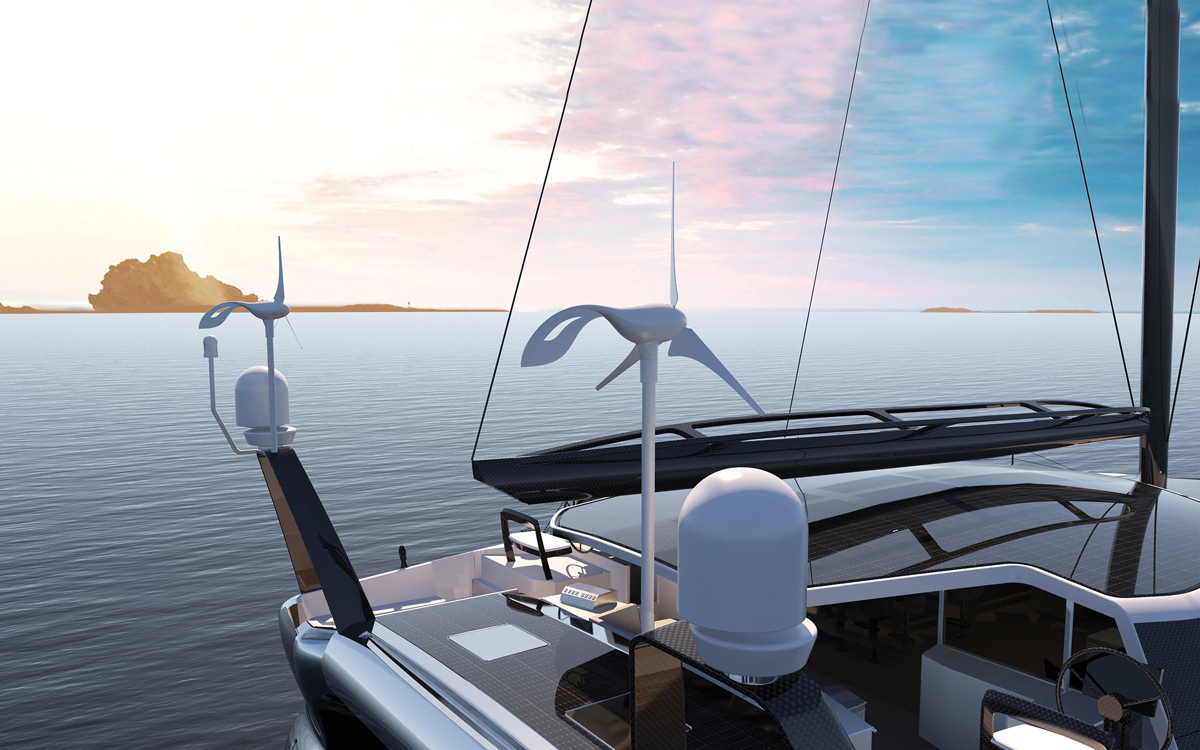
This hydrogen electric cat is midway through build at Daedalus in North Carolina
The Simple Solution
Technology continues to simplify yacht operation, addressing the needs of an increasingly busy society. Easy daysailing will be essential for potential sailors, while powerboaters interested in eco-friendly options will seek user-friendly designs that facilitate quick rigging, docking, and management.
Many boatbuilders are integrating greener propulsion systems and sustainable energy sources, with a growing trend towards using natural and recyclable materials. Regardless of regulation, it’s a rational choice if consumers demand more ethically produced products.
In the next ten years, we can expect a significant rise in the use of 3D printing for boatbuilding. Already utilized for custom parts, this technology holds the promise of enabling whole hulls and decks to be printed—eliminating the need for wasteful molds via structures encased in natural fiber skins.
Search for Speed
The most straightforward way to reduce your carbon footprint while sailing is, quite simply, to sail more. This leads to a compelling argument for selecting performance yachts, which can harness the wind more effectively. Larger yachts and catamarans have an edge here, as they can accommodate multiple solar panels and implement regenerative propulsion systems.
Insights from projects such as Outremer 4E elucidate that a yacht’s operational emissions are often far greater than those incurred during its construction. With the right conditions, a sailor can use wind power to navigate effectively in the Mediterranean almost year-round.
Boats from Plants?
Flax fibers, deriving from the plant that produces linen, are emerging as a potential game changer for boatbuilding. Bcomp, a Swiss company, has seen success using flax in motorsport applications due to its impressive strength-to-weight ratio.
Paul Riley, a composites consultant for Bcomp, notes that flax biomass is lighter than traditional glass fibers while offering similar rigidity and significant cost advantages compared to carbon fibers, all while reducing CO2 emissions by up to 75%. He predicts this material will become mainstream in yachting within the next few years.
Growing rapidly with minimal irrigation or chemicals, flax has already found application in projects from notable yards like Greenboats and Baltic Yachts, with prospective partnerships likely promoting broader adoption across the industry.
Recyclable Boats
As awareness grows about environmental sustainability, the focus on recyclable materials has intensified. Advanced technologies yielding recyclable thermoplastic composites, as seen in the construction of boats like Arkema 3, support future projects aiming for a cleaner end-of-life for vessels.
Aluminium and wood composite hulls offer pathways for recycling and reduce the dependence on traditional molds, providing a secondary life for materials often discarded.
Going Electric
Electric propulsion is gaining traction, with companies like Torqeedo and Oceanvolt at the forefront, while Volvo Penta is now enhancing its emphasis on electromobility technologies. To date, only around 1.3% of marine propulsion systems are electric, highlighting significant potential for growth.
Ballin forecasts a future dominated by serial hybrid power systems that combine large battery banks with solar and hydro power generation, slashing CO2 emissions by approximately 90%. Such hybrid systems could cater to everyday energy needs while eliminating reliance on combustion engines.
Hydrogen Power
Hydrogen energy offers intriguing possibilities for yachts. While some pioneering vessels have incorporated hydrogen fuel cells, economic feasibility remains challenging for many leisure yachts due to space constraints for storing hydrogen.
Yet, innovative projects such as the hydrogen-powered superyacht being crafted by Daedalus Yachts are pushing boundaries. With a clean energy microgrid aimed at sustainable cruising, technologies previously used in high-stakes applications provide solid grounding for future maritime hydrogen ventures.
The upcoming decade promises not just innovation but a collective shift towards sustainability in the marine industry. As we explore materials derived from the earth and renewable energy sources, the horizon suggests a future filled with eco-friendly possibilities.
First published in the April 2020 edition of Yachting World.